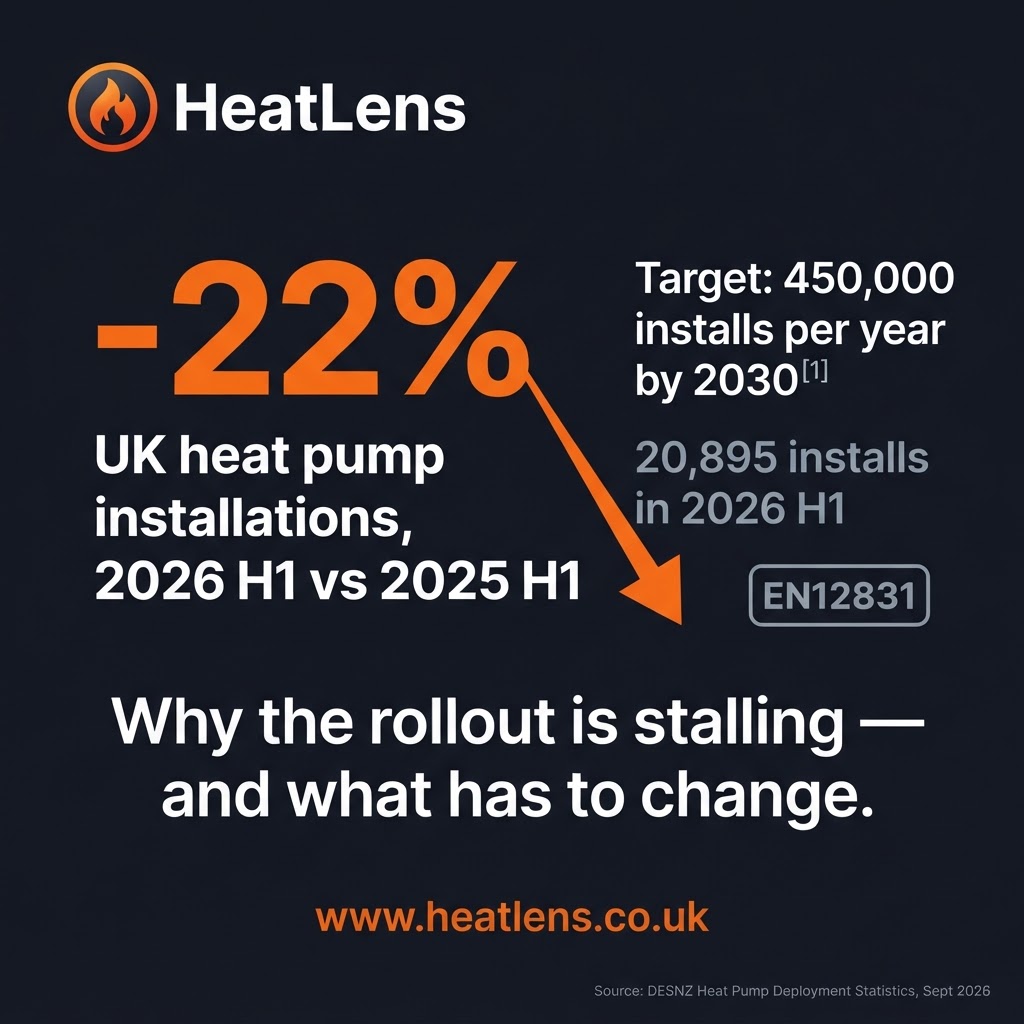
Two government datasets published weeks apart appear to tell opposite stories about the UK heat pump market. In September 2026, DESNZ reported that retrofit heat pump installations fell 22% in the first half of the year. In July, Ofgem reported that Boiler Upgrade Scheme applications rose 19% in 2025/26. And in August, DESNZ's own monthly figures showed a record 8,150 applications in July 2026 — up 112% year-on-year.
Both are correct. The apparent contradiction dissolves once you look at what each number actually counts.
Three datasets, three different things
DESNZ Heat Pump Deployment Statistics (published 10 September 2026). These count retrofit heat pump installations across the UK — England, Wales, Scotland and Northern Ireland. Since March 2026, coverage expanded from government-supported installations only to all MCS-certified retrofit installations, including self-funded. New-build properties and non-MCS-certified installs are excluded. The figures carry the designation "Official Statistics in development," meaning the methodology is still evolving.
For 2026 up to the end of Q2 (January to June), the count was 20,895. The same period in 2025 was 26,768. That is a 22% fall. The full-year 2025 figure was approximately 53,250 retrofit installations — a 9% increase on 2024 (48,857) and more than four and a half times the 2020 figure (11,327). The long-term trend is upward. The latest six months bucked it.
Ofgem Boiler Upgrade Scheme Annual Report (published 31 July 2026). This covers scheme year 4, running 1 April 2025 to 31 March 2026. It counts BUS applications and grants paid in England and Wales only. In that year, 45,880 applications were received — up 19% on the previous scheme year. Vouchers worth £295.5 million were issued. Grants totalling £233.1 million were paid, supporting 31,104 installations. Since the scheme began in May 2022, 80,098 systems have been supported, 97.6% of them air source heat pumps. 1,789 active installers are registered; the top 10 account for 36.5% of applications.
Nesta's analysis (published 30 April 2026). Drawing on BUS administrative data, Nesta reported that BUS supported 30,600 air source heat pumps in 2025/26, up from 24,700 the previous year — a 24% increase. That growth rate is a deceleration: the prior year was up 69%. Nesta's assessment is that at 24% annual growth, BUS would support approximately 59,000 installations by 2029/30 — 39% of what they estimate is needed to meet the government's 450,000-per-year target by 2030.
Scope, period, measure
The three numbers answer different questions. DESNZ asks: how many heat pumps were actually installed in existing UK homes? Ofgem asks: how many grant applications did we process in England and Wales? Nesta asks: how many of those grants turned into ASHP installations?
The differences matter in three ways.
Geography. BUS operates in England and Wales. DESNZ covers the whole UK. In the first half of 2026, only Northern Ireland and London saw growth in retrofit installations. The rest of England, Wales and Scotland fell.
Timeline. Ofgem and Nesta report a scheme year (April to March). DESNZ reports calendar quarters. The 22% fall covers January to June 2026. The 19% application rise covers April 2025 to March 2026. The record July applications fall outside both periods — and will not appear in published installation counts until the December 2026 release.
What is counted. Applications are intent. Vouchers are issued after a pre-installation eligibility check. Grants are paid after installation is verified. Installations are completed work. Each stage has a drop-off: from 45,880 applications to 39,435 vouchers issued to 31,104 grants paid — roughly 68% of applications ultimately result in a grant being paid. That pass-through rate is stable, which means application volume is a reasonable forward indicator, with a lag.
What the gap tells us
The most useful comparison is between BUS-supported installations (growing) and total retrofit installations (falling). BUS covers England and Wales only, but it is the largest single route to market for retrofit heat pumps. If BUS-supported installs are rising while the total is falling, the non-BUS part of the retrofit market — self-funded installations, and programmes like the Energy Company Obligation and the Warm Homes Social Housing Fund — is shrinking faster than BUS growth can offset.
HPA UK offered a partial explanation in June 2026. Their data showed heat pump sales for heating buildings grew 5% in Q1 2026 compared to Q1 2025. But the share going into new-build properties rose from 55% to 61%. New-build installs were 38% higher year-on-year. HPA UK attributed the retrofit decline to the closure of the Energy Company Obligation and slower deployment through the Warm Homes: Social Housing Fund — factors affecting funded retrofit, not private self-funded installs.
That distinction matters. The total retrofit figure includes programmes that have closed or slowed. The decline may partly reflect policy transitions rather than market demand.
The July spike
The record 8,150 applications in July 2026 deserve context. DESNZ sent information about enhanced support to 200,000 eligible homes in June. The off-grid grant uplift to £9,000 took effect on 21 July. Oil-heated homes, which make up a large share of off-grid properties, appear to be driving the increase.
DESNZ themselves note that the July increase should not be attributed to one factor alone. A spike following a policy launch and a targeted mailout may represent pent-up demand released at once rather than a new sustained rate. Whether it converts to installations will show in the December release.
The 17% headline
One more number is widely quoted and worth unpacking. MCS reported that 210,000 certified renewable installations were completed in the first half of 2026, up 17% on the previous best start to a year. That figure is correct. The breakdown: 148,531 solar PV, 36,478 battery storage, and 25,411 heat pumps.
Solar and battery are driving the growth. Heat pumps are the one technology going backwards. Promoting the 17% headline without noting that breakdown is not wrong — the number is accurate — but it obscures the signal most relevant to heat policy.
The 25,411 MCS-certified heat pump figure also exceeds the DESNZ retrofit count of 20,895 by roughly 4,500. The gap is largely new-build: MCS certifies installations in all property types, while DESNZ's deployment statistics exclude new-build. The total H1 2026 heat pump market is closer to 25,000 once new-build is included — though the retrofit segment, the part directly affected by BUS, is the one in decline.
A note on methodology
The DESNZ deployment statistics carry the designation "Official Statistics in development." Coverage expanded from government-supported installations only to all MCS-certified retrofit installations from March 2026, meaning year-on-year comparisons for 2026 may involve a partially different base. Historical figures appear to have been recalculated on the expanded basis, but the methodology is still being refined and the figures are provisional.
The practical implication: the 22% decline is reported by the publishing body as a genuine fall. But the precise magnitude may be revised as the methodology settles.
What this means
The picture, assembled honestly: government grant support for heat pumps is working. Applications are at record levels, the budget is funded, and the scheme is growing. But the completed installation count is falling, partly because programmes outside BUS have closed or slowed, and partly because the BUS growth rate is decelerating even as its budget expands. The July spike may prove to be a turning point or a one-off. The next data lands in December.
Until then, anyone citing a single number to support a position about the health of the UK heat pump market is choosing the dataset that fits.
Sources and limitations
-
DESNZ Heat Pump Deployment Statistics, June 2026 release (published 10 September 2026). Covers UK retrofit MCS-certified installations only. Designated "Official Statistics in development." Excludes new-build and non-MCS-certified installations. Methodology expanded from government-supported-only to all retrofit from March 2026. Full-year 2025: ~53,250 (9% increase on 2024: 48,857). H1 2026: 20,895 (22% fall on H1 2025: 26,768). Regional split available but property counts differ by area. Next release December 2026.
-
Ofgem Boiler Upgrade Scheme Annual Report, April 2025 to March 2026 (published 31 July 2026). Covers England and Wales only. Scheme year April 2025 to March 2026. 45,880 applications, 39,435 vouchers issued (£295.5m), 31,104 grants paid (£233.1m). 97.6% of grants since launch were for ASHPs; 76.3% replaced fossil-fuelled systems. 1,789 active installers; top 10 responsible for 36.5% of applications. Compliance audit rate: 93.1%. Total since May 2022 launch: 80,098 systems, £560.3m paid.
-
Nesta, "Four years of the Boiler Upgrade Scheme in four charts" (30 April 2026). BUS supported 30,600 ASHPs in 2025/26, up 24% from 24,700. Previous year growth: 69%. At 24% annual growth, BUS would deliver ~59,000 in 2029/30, versus ~150,000 needed for the 450,000/year target. Median installation cost: £13,041 (up 0.4% on £12,973). Budget: £295m in 2025/26, up from £180m in 2024/25. Based on BUS administrative data for England and Wales. Nesta's forward projection assumes constant growth rate, which may not hold.
-
MCS H1 2026 data (published August/September 2026). 210,003 total certified installations in H1 2026, up 17% on the previous best start to a year: 148,531 solar PV, 36,478 battery storage, 25,411 heat pumps. MCS certifies installations in all property types including new-build; DESNZ retrofit statistics exclude new-build.
-
HPA UK Q1 2026 sales data (June 2026). Heat pump sales for heating buildings up 5% Q1-on-Q1. New-build share of sales rose from 55% to 61%; new-build installs up 38% year-on-year. HPA UK attributed the retrofit decline to ECO closure and slower Warm Homes: Social Housing Fund deployment. HPA UK counts sales (factory gate); DESNZ counts installations. A ~19k adjustment for "other heat pumps" and DHWHPs was needed to make the two comparable. HPA UK data includes manufacturer sales estimates covering ~90% of the market.
-
DESNZ BUS monthly statistics (published 27 August 2026). July 2026: 8,150 applications (record month, up 81% on June, up 112% on July 2025). 49% of grants since launch went to rural households; 38% to off-gas-grid homes. DESNZ sent information to 200,000 eligible homes in June 2026. DESNZ cautions against attributing the July increase to one factor alone. Applications measure intent, not completed installations.
-
Boiler Upgrade Scheme grant levels, including the £9,000 off-gas uplift: GOV.UK, Boiler Upgrade Scheme: what you can get (checked 9 October 2026). £7,500 for an air source or ground source heat pump, plus £1,500 (so £9,000) for an off-gas home heated by oil or LPG, until March 2027.