Heard of them, but not yet trusted
Most householders have now heard of heat pumps, but far fewer feel they understand them. The UK government's Public Attitudes Tracker for Spring 2026 puts awareness of air source heat pumps at 78%, yet only 28% of people say they know a fair amount or a lot about them. Among owner-occupiers, 26% say they are likely to install one or already have one [1].
The confidence gap Most people have heard of heat pumps. Far fewer feel confident about them. Source: DESNZ Public Attitudes Tracker, Winter 2025 and Spring 2026 waves, UK adults (likelihood to install: owner-occupiers only).
That gap between hearing about something and trusting it is where communication does its work. Having spent years modelling how buildings actually use energy, I'm struck by how often the public conversation lands at one of two extremes. Some content is so simple it skips the questions people actually have, like "will my house be warm?" Other content dives straight into flow temperatures, weather compensation and SCOP before anyone has asked.
The good news is that the mix of voices has never been richer. TV presenters, YouTubers, installers, comedians, charities and neighbours are all now explaining heat pumps, and each reaches a different kind of person. This post looks at what's out there, what the evidence says people need, and how we might pitch the message at the right level.
Heat pumps on prime-time TV
Channel 4's Guy Martin's House Without Bills, first broadcast on 9 February 2026, took an ordinary 1930s semi in Stretford, Greater Manchester, and set out to cut its bills to almost nothing. Nesta co-funded the programme through its Greener Homes work, and North One produced it [2].
What I like about this format is that it meets people where they already are. Guy Martin isn't a heating engineer, and that's the point: he asks the questions a curious homeowner would ask. The show explains how a heat pump works with a hands-on mock-up. It tackles the noise worry by measuring a heat pump next to a gas boiler. It also brings in Professor Richard Fitton from the University of Salford's Energy House 2.0 to explain something anyone can do tomorrow: turn down the flow temperature on an existing boiler.
Guy's opening line sums up the whole communication challenge: "I don't think you can have an educated opinion on air source heat pumps until you understand how they work." He then shows the physics instead of asserting it. A bicycle pump stands in for the compressor. The propane refrigerant boils at around minus 42°C, so even a British cold snap leaves plenty of heat in the outdoor air. After standing between a gas boiler flue and his new outdoor unit, his verdict on noise is simple: "Loads of people say they're dead noisy. Not anymore."
The programme is honest about the harder parts too: the hot water cylinder needs a home, and commissioning takes hours of careful balancing. That honesty is what makes the positive message credible.
The follow-up on Guy Martin's own website is refreshingly grounded [3]. It puts insulation, draught-proofing and ventilation first, passes on a warning he was given that more heat pumps are fitted badly than fitted well, and points readers to Nesta's Visit a Heat Pump service. That's a big message delivered in plain language, to an audience that would never search for "heat pump design".
The short clips that spin out of series like this do a different job again. They won't answer every technical question, and they aren't meant to. Their job is to make heat pumps feel normal, and to send people off to find out more. Nesta has pushed the same idea further, working with Parents for Future UK and a writers' room of comedians led by Matt Winning to produce short heat pump sketches for Instagram [4].
The creators filling the gap
Alongside broadcasters, a whole ecosystem of creators has grown up around heat pumps. They vary hugely in depth, and that range is useful in its own right. Here's a rough map of the styles I see and who each one serves best.
Who's talking about heat pumps Every voice has a place, from first spark to deep dive Light touch TV features Channel 4's House Without Bills, with Guy Martin Comedy sketches Nesta with UK comedians, on Instagram Visit a Heat Pump Nesta's network of owners who host visits Local installer-creators Aventus Eco, Douglas Renewables, Allen Hart and others filming real jobs Getting practical Skill Builder Trade channel following real projects over time Homeowner diaries Real bills and readings from owners' blogs Everything Electric Whole-home electrification for enthusiasts Homeowner-side advice The Heating Hub and the Renewable Heating Hub
| Voice | Style | Depth | Best for |
|---|---|---|---|
| TV features like House Without Bills | Story-led, a familiar presenter, a real house | Light | People who've never thought about their heating |
| Comedy sketches from Nesta and UK comedians on Instagram | Short, funny, shareable | Very light | Reaching people who'd never click on "energy" content |
| Skill Builder | Trade-focused, frank, follows real projects over time | Medium | Sceptics and DIY-minded homeowners |
| Heat Geek | Installer training plus homeowner explainers and live data | Medium to deep | People ready to get quotes who want to know what "good" looks like |
| Industry podcasts such as Nathan Gambling's BetaTalk | Long-form conversation | Deep | Installers and very engaged homeowners |
| Everything Electric (Fully Charged) | Enthusiast, whole-home electrification | Medium | Early adopters, often EV and solar owners |
| Homeowner blogs and data diaries, such as energy-stats.uk | First-person, real bills and readings | Medium | People who trust a peer more than a brand |
Two more groups deserve a mention. Homeowner-side advice sites such as The Heating Hub and the Renewable Heating Hub help people with sizing, quotes and grant paperwork; The Heating Hub also runs its own installer network, so it sits a little closer to the trade. And a growing number of heating engineers on YouTube, including Leeds engineer Allen Hart and the Plumberparts channel, film real jobs in the kinds of period semis and terraces people recognise. When you can watch a neat install in a house like yours, an abstract technology becomes an ordinary job.
The best example of trust-building I found is the Skill Builder and Heat Geek story [5]. A homeowner's original system kept freezing up, was noisy and ran inefficiently, and they considered going back to gas. After Heat Geek redesigned it, Skill Builder's one-year follow-up reported running costs of about £920 a year to heat a six-bedroom home at a constant 20°C, on a 15p/kWh tariff secured through a special deal. Showing a failure, a fix and a year of results is more convincing than any glossy promise.
Local installers as trusted sources
Perhaps the most powerful voice of all is the local installer who shows their own work. After I shared an earlier version of this piece, retrofit case study filmmaker Matt Milloy made the point that this is often what tips someone from curious to buying [14]. His recipe is simple: a clear website, the installer's own social channels, and video case studies of local house types people recognise, with performance clearly shown. No paid ads or lead-generation platforms sit between the installer and the customer.
It works because it answers the question every homeowner really has: "has this worked in a house like mine, near me?" National campaigns and accreditation schemes build the wider foundation of trust; a local installer filming the semi down the road turns that trust into a decision. It's also a model that small firms on lean margins can run themselves.
A few examples show what this looks like in practice:
- Aventus Eco, central Scotland. Managing director Sean Hogan runs a design-first business focused on low-temperature systems, with filmed case studies of real homes (Refurb and Retrofit) and regular appearances on the Renewable Heating Hub's homeowner Q&A podcast [15] [16]. Matt Milloy, quoted above, made those films.
- Douglas Renewables, Roslin, Midlothian. A Heat Geek certified installer whose website explains each service in plain detail, backed by installation photos and customer reviews. Their TikTok channel publishes detailed videos of their installs, giving potential customers a clear picture of what's involved [17].
- Allen Hart, Leeds. A heating engineer whose YouTube and TikTok channels bring everyday jobs, including heat pump installs, to a large audience [18].
These aren't endorsements or a ranking, and there are many other good firms doing the same. The common thread is what to look for: real local case studies, clear explanations, and performance shown rather than promised.
I've focused on UK and Irish voices here. US channels like Technology Connections and Matt Ferrell's Undecided also have large audiences, but their homes, climate and prices differ from ours.
Official efforts are getting smarter too
Governments and charities are moving from leaflets towards seeing, hearing and testing.
- Seeing one in person. Nesta's Visit a Heat Pump connects curious householders with local owners who host visits. It launched nationally in April 2024 with around 150 hosts. Two years on, more than 1,200 owners have registered as hosts and nearly 2,500 visits have taken place [6]. The idea is simple: people trust what they can hear and touch in a real home.
- Tackling myths head-on. The UK government has commissioned the Behavioural Insights Team, under a contract worth about £90,000 before VAT, to study householder views and media coverage and develop a response to heat pump misinformation [7].
- Factchecking with evidence. Carbon Brief's factcheck of 18 heat pump myths, last updated in August 2025, is still one of the best single references to point people towards [8].
- Real-world data. Open projects like HeatpumpMonitor.org publish live performance from real homes. Across 169 monitored air source systems, the average seasonal performance factor is 3.86 [9]. These are self-selected, well set-up systems, so they show what good looks like, which is exactly what a homeowner needs to see.
In Ireland, the challenge looks a little different. Researchers at TU Dublin's Irish Building Stock Observatory describe a "comfort barrier" [10]. Over a third of Irish homes are C-rated and feel comfortable enough, so owners see little reason to change. In 2025, 4,360 Irish homes drew down SEAI heat pump grants, against more than 30,000 solar PV grants. That's a communication problem as much as a technical one: the message has to be about a better home for people whose home already feels fine.
What householders actually need
The research points to confidence as the missing ingredient, more than raw information. A few findings stand out.
- Feeling informed and being informed are different things. Government research quoted in the misinformation contract found that people who said they knew a fair amount or a lot about heat pumps were less likely to want one, while people who correctly answered a simple factual question about them were more likely to want one [7]. A little knowledge, picked up from headlines, can harden doubts.
- The same worries keep coming back. Noise, cost, reliability and "won't work in my old house" top the list. Of the 18 common claims Carbon Brief checked, it rates 13 as false and 5 as misleading [8].
- Owners are often happier than the headlines suggest. In an Octopus Energy survey of more than 1,800 UK households during cold weather, 66% of heat pump owners were satisfied with their running costs, against 43% of gas boiler users [9].
- Some groups are still being missed. The Public Attitudes Tracker shows that people aged 55 and over, and households on lower incomes, are much less likely to consider a heat pump [1].
The large-scale evidence backs the positive story:
- A wide range of homes worked. The government-funded Electrification of Heat project, run by Energy Systems Catapult, installed 742 heat pumps, 68% of them in homes built before 1980, across detached and semi-detached houses, terraces and flats. 85% of participants had recommended, or were likely to recommend, a heat pump to friends or family [11]. I've looked at what the same trial says about running costs in an earlier post.
- Owners compare well with boiler users. In Nesta's survey of 2,395 heat pump owners and 1,025 gas boiler owners, carried out by Eunomia and published in 2023, 81% of heat pump owners were as satisfied or more satisfied with their heat pump than with their previous heating system. For running costs, 67% of heat pump owners were satisfied, against 59% of boiler owners [12].
- Controls are the weak spot. The same survey found only 74% of heat pump owners satisfied with ease of use and control, against 88% for boilers [12]. That points straight at the "living with it" stage below.
- For many people, it still feels like a gamble. Which?'s June 2026 report Beyond Affordability found that even homeowners who can afford a heat pump hesitate [13]. They describe the market as a "Wild West", want a trusted standard along the lines of Gas Safe, and show almost no awareness of MCS.
The honest caveat matters too. Guy Martin's follow-up passes on the warning that a lot of systems are fitted badly. Good communication doesn't pretend otherwise; it explains what a good installation looks like, so people can ask for one.
Too basic or too advanced? Think in layers
Content that's "too basic" for one person is exactly right for another. Problems arise when someone gets the wrong layer at the wrong moment. I find it helps to think of a householder's journey as a ladder, where each rung asks a different question.
Pitching it right Too basic or too advanced? It depends which step you're on. Each stage of a homeowner's journey asks a different question. Good content meets people where they are, then points to the next step. Curious "Is this for people like me?" What helps Stories, humour, familiar faces Who does it well TV, comedians, social clips Considering "Will it keep me warm, and what will it cost?" What helps Myth-busting, real bills, hearing one running Who does it well Factchecks, homeowner diaries, Visit a Heat Pump Getting quotes "What does a good installation look like?" What helps Heat loss survey, radiator sizing, flow temperature Who does it well Installer channels, trusted advisers Living with it "How do I run it well?" What helps Settings, tariffs, monitoring Who does it well Owner communities, open data projects
| Stage | The question they're asking | What helps most | Who does it well |
|---|---|---|---|
| 1. Curious | "Is this for people like me?" | Stories, humour, familiar faces | TV, comedians, social clips |
| 2. Considering | "Will it keep me warm, and what will it cost?" | Myth-busting, real bills, hearing one running | Factchecks, homeowner diaries, Visit a Heat Pump |
| 3. Getting quotes | "What does a good installation look like?" | Plain-English checklists: heat loss survey, radiator sizing, flow temperature | Installer channels, trusted advisers |
| 4. Living with it | "How do I run it well?" | Settings, tariffs, monitoring | Owner communities, open data projects |
A few principles follow from this:
- Signpost the next rung. A great TV moment should end with "here's where to learn more", so people aren't left hanging.
- Lead with comfort, then cost, then carbon. People buy warm, quiet, affordable homes. Efficiency figures matter later.
- Translate the jargon instead of hiding it. Terms like "flow temperature" are worth teaching, because they're what homeowners need to ask installers about.
- Show real homes and real numbers. Before-and-after data, including honest setbacks, builds more trust than a showroom.
- Celebrate the whole ecosystem. The comedian, the presenter and the heating engineer are all doing different parts of the same job.
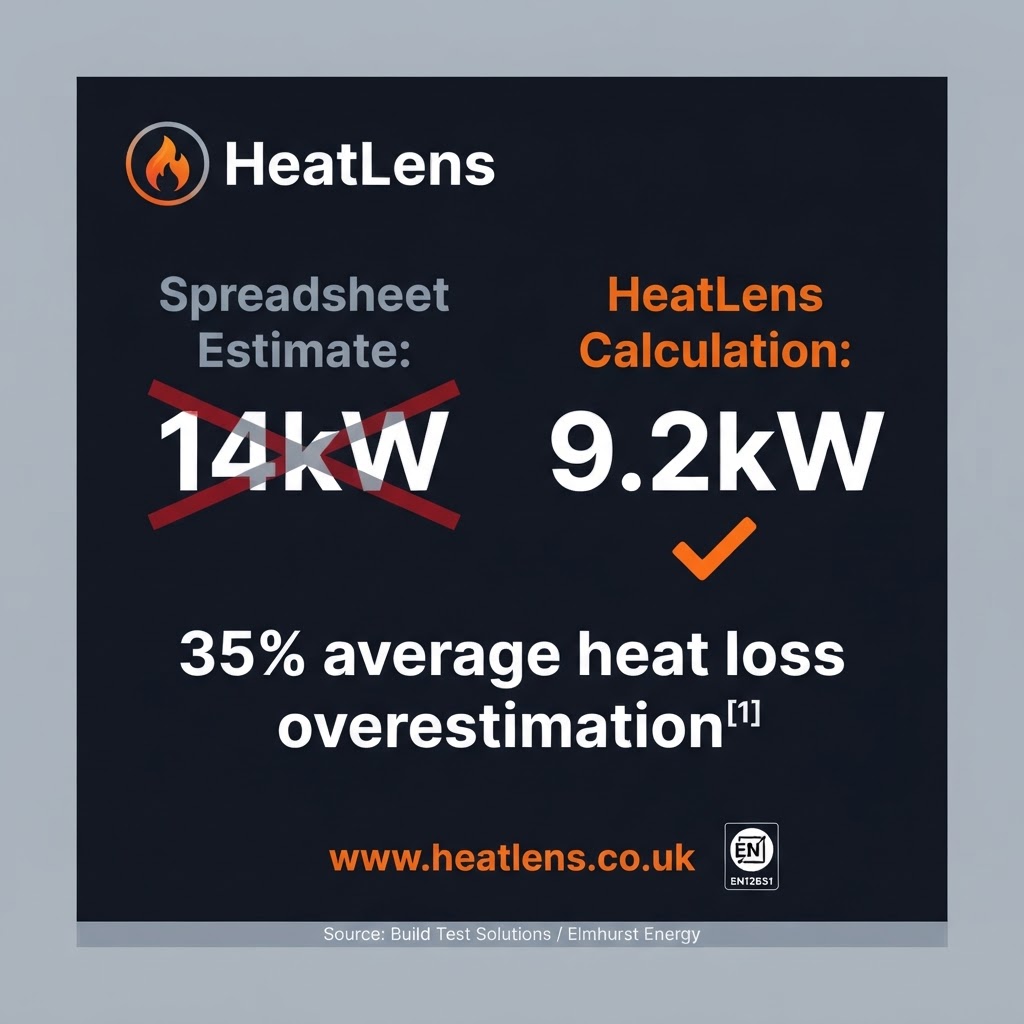
There's one gap the ladder makes visible: the missing middle. Basic content is kind and true (it's like a fridge in reverse, there's a grant, it will keep you warm), but it doesn't prepare anyone for the questions that decide the outcome. What flow temperature is the system designed for? Which radiators need upsizing? Why did the quotes for my own house range from 5 kW to 10 kW? Advanced content answers all of that, but in the language of the trade. What's needed in between is home-specific clarity: what the numbers mean for this house, this living room, this radiator under the window.
I wrote about that spread of quotes, and what it says about the inputs behind a heat loss figure, in From 10 kW to 5 kW.
Where HeatLens fits
Full disclosure: we are building HeatLens, and the missing middle is the reason it exists. You upload an EPC and a floor plan, and it produces the room-by-room picture: where the heat is lost, which radiators would struggle at a low flow temperature, what size heat pump the house is likely to need, and what the running costs look like across tariffs, before anyone commits. The free plan includes one project, because good information should not depend on what you can afford.
Try it on your own home. Start a project in HeatLens from your floor plan and EPC.
The conversation is moving in the right direction
There's real reason for optimism. Knowledge of air source heat pumps in the UK rose from 24% to 28% between Winter 2025 and Spring 2026, and the share of owner-occupiers who are likely to install one, or already have one, has climbed from 19% in Winter 2021 to 26% [1]. Heat pumps are on prime-time TV, in comedy sketches and in neighbours' back gardens. That's what normal looks like.
Louder messaging won't close the remaining gap. Joining the dots between the voices will, so that someone inspired by a TV show can find a trusted explainer, a real home to visit and a good installer. Everyone who talks about heat pumps, from creators to engineers to consultants like me, can help by knowing which rung their audience is on, and pointing to the next one.
If you're thinking about a heat pump, start with a question you really care about, and find someone who has already answered it in their own home.
References
- DESNZ (2026). Public Attitudes Tracker: Heat and energy use in the home, Spring 2026, UK.
- Nesta. Guy Martin's House Without Bills. Guy Martin's House Without Bills, Channel 4 / North One, first broadcast 9 February 2026; quotes from the programme.
- Guy Martin. House Without Bills update.
- Nesta. Collaborating with comedians to boost heat pump awareness on social media.
- Skill Builder. Heat Geek's heat pump one year later: the verdict.
- Nesta (2026). More than 1,200 heat pump owners have registered with Nesta's Visit a Heat Pump scheme as it celebrates two years since launch.
- DESNZ commissioning documents for the Behavioural Insights Team heat pump misinformation research, published on Contracts Finder; reported by The Eco Experts.
- Carbon Brief (2023, updated August 2025). Factcheck: 18 misleading myths about heat pumps.
- ACR Journal (2026). Heat pumps work: will 2026 be the year we finally change the narrative? Octopus Energy survey and HeatpumpMonitor.org data.
- TheJournal.ie (2026). The "comfort barrier" in Irish heat pump uptake, citing research from the Irish Building Stock Observatory, TU Dublin, and SEAI grant figures.
- Energy Systems Catapult (2024). Heat pumps recommended by 85% of consumers; Electrification of Heat demonstration project summary report.
- Nesta and Eunomia (2023). Heat pumps: a user survey.
- Which? (2026). Beyond Affordability: why heat pumps feel like a gamble.
- Matt Milloy, retrofit case study filmmaker and founder of Retrofit.Video, LinkedIn (October 2026).
- Refurb and Retrofit (2026). Can heat pumps work in cold weather? A video case study with Aventus Eco.
- Renewable Heating Hub. Aventus Eco: installer spotlight.
- Douglas Renewables, Roslin, Midlothian.
- Allen Hart, Leeds.
HeatLens figures are based on EPC and floor plan information, which may contain inaccuracies. Designs must be checked and surveyed by a qualified MCS installer. If you think any figure here is wrong, we would rather know: info@heatlens.co.uk.