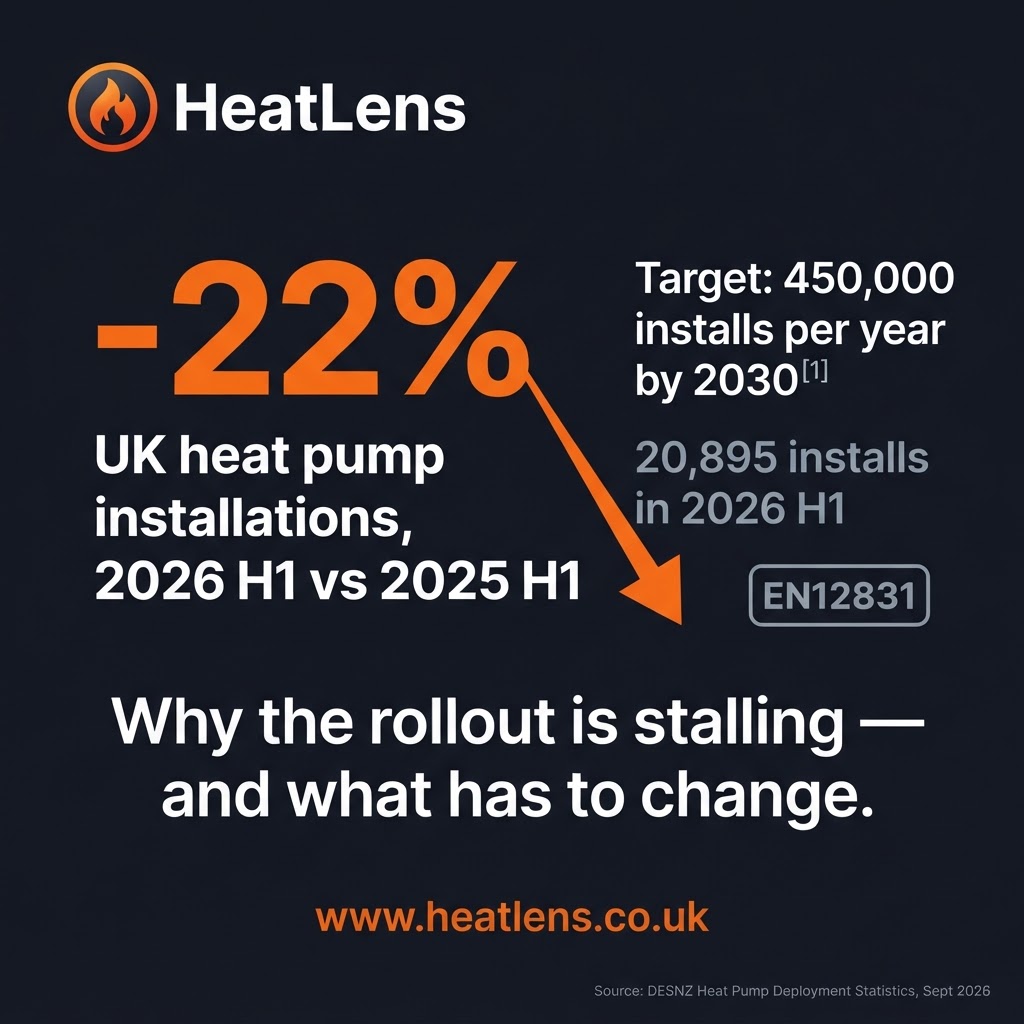
Most people in the UK have now heard of heat pumps. Far fewer feel they understand them. The government's Public Attitudes Tracker for Spring 2026 puts awareness of air source heat pumps at 78%, but only 28% of people say they know a fair amount or a lot about them [1]. Which?'s research this summer found that even homeowners who can afford a heat pump describe the decision as a gamble [2].
We think a lot of that gap comes down to how hard it still is to get a straight answer about your own home. Good heat pump advice exists, but it is spread across guides, forums, videos and quotes, and very little of it starts from the house you actually live in or the job you are actually quoting. Today we're introducing Ember, the assistant built into HeatLens, as one step towards closing that gap, for homeowners making sense of their options and for the installers and designers doing the work.
Meet Ember: a minute with the assistant in HeatLens. The chats are an illustration and the bill figures are examples.
The missing middle in heat pump advice
In Getting the heat pump message right we described a gap in the information people find. Introductory content is friendly and true: a heat pump is like a fridge in reverse, there's a grant, it will keep you warm. Technical content is thorough, but written in the language of the trade. What's often missing is the middle: what the numbers mean for this house, this living room, this radiator under the window.
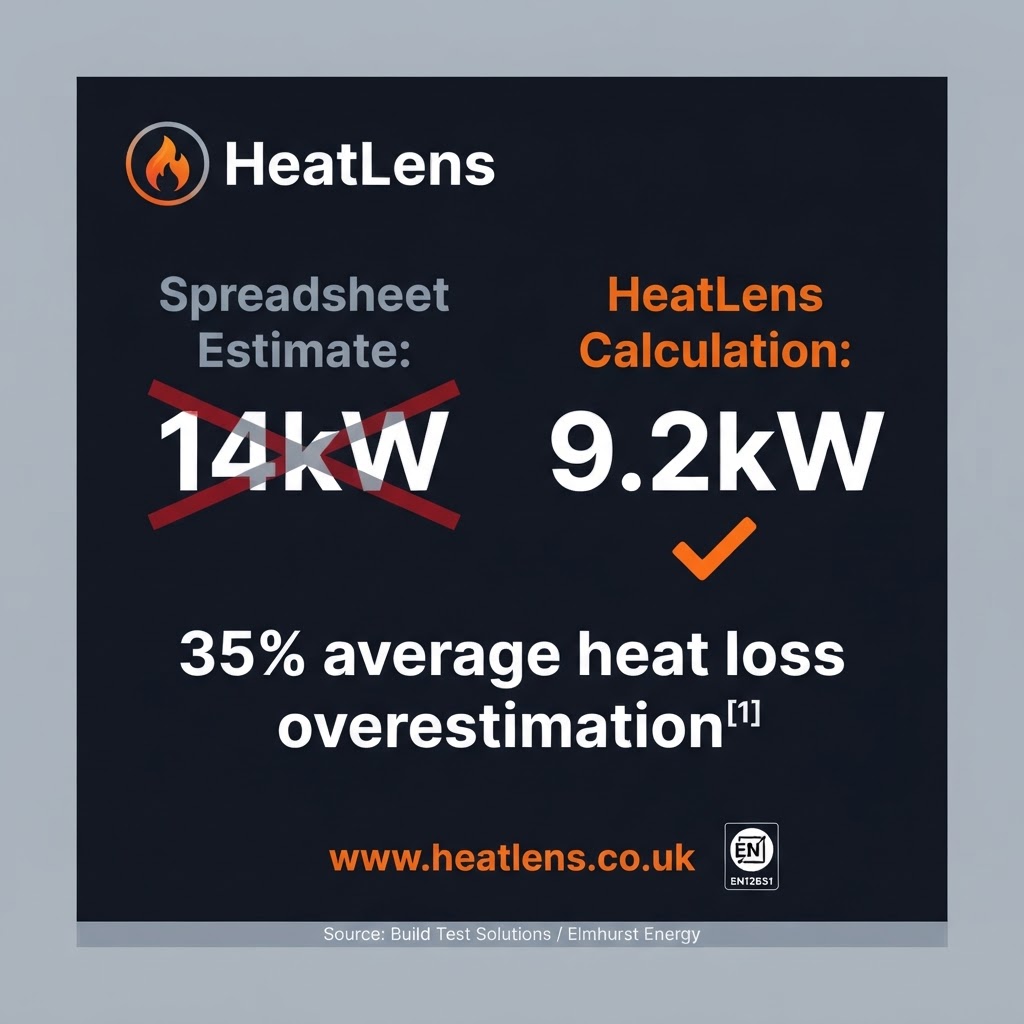
That middle is also where the answers start to differ. When we collected ten quotes for one house, the recommended heat pump sizes ranged from 5 kW to 10 kW (Heat pump sizing uncertainty). No general guide can tell you which of those is right. The detail of the house can.
Answers that start from your home
Ember sits in the corner of every HeatLens screen: a small flame in glasses. Open it inside a project and it works from that project: the rooms and radiators, the live heat loss result on screen, the scenarios and tariffs, and any documents you have added, such as an EPC or a quote.
That changes the kind of question you can ask. Instead of "how big should a heat pump be?", you can ask what size this house needs and why. Instead of "will I need bigger radiators?", you can ask which rooms would struggle at a lower flow temperature. Where an input is missing or assumed, Ember says so rather than filling the gap with a guess.
For general questions, such as how the Boiler Upgrade Scheme works, Ember can search the web and tells you the source it used, because grants, tariffs and standards change.
The same facts, at the right level
Pitching information at the right level matters as much as the information itself. Ember adjusts to who is asking. A homeowner gets a short answer in plain words: what it means for the home, the one caveat that matters, and a few next steps. An installer or designer gets the technical version, with the design conditions and the inputs that need checking. Either can ask for more, and answers stay short enough to read on a phone.
For homeowners, that can mean help with the questions to put to an installer: what flow temperature the system is designed for, which radiators need changing, and what the heat loss survey covered. Attach a quote and Ember can point out what it includes and what it doesn't mention. Inside a project you can also request a callback from the chat window if you would rather talk it through.
Less admin between survey and install
For installers, every minute spent re-typing details is a minute not spent on the parts of a survey that decide the design. In Where a heat pump survey should spend its time we looked at which inputs actually move the heat pump size. Most of the effort belongs there, not on paperwork.
Ember helps with the rest. Tell it what you would tell a colleague, such as "survey's booked for 4 November, single-phase, 100 A fuse, looped supply", and it proposes the exact fields it would update. Nothing changes until you approve, and afterwards it lists what changed. Ask "what's still missing before I can quote?" and it checks the job against the calculation and names what is blocking it. Attach an EPC, a bill or a quote and the file is saved with the job's documents, so the evidence stays with the project rather than in a chat.
 Ember in HeatLens
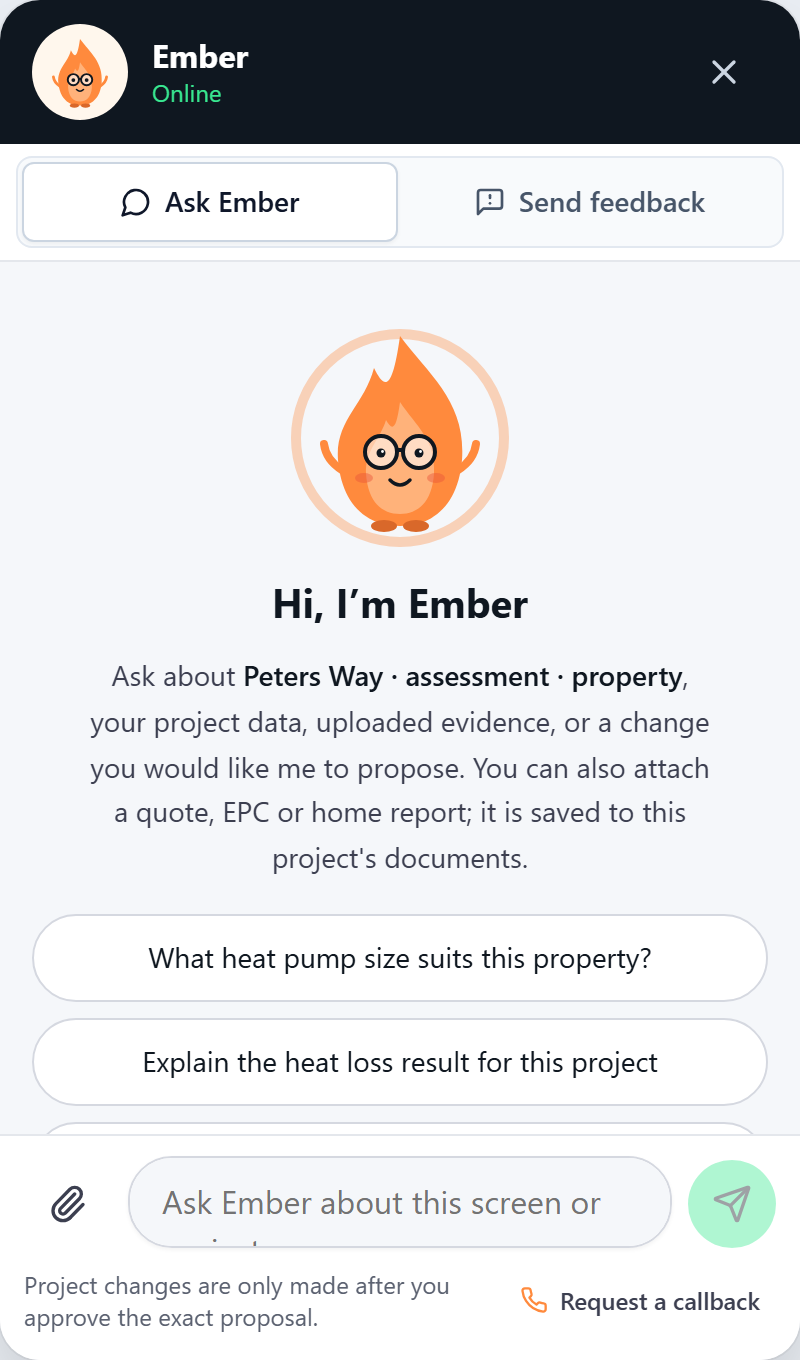 Open Ember on any project
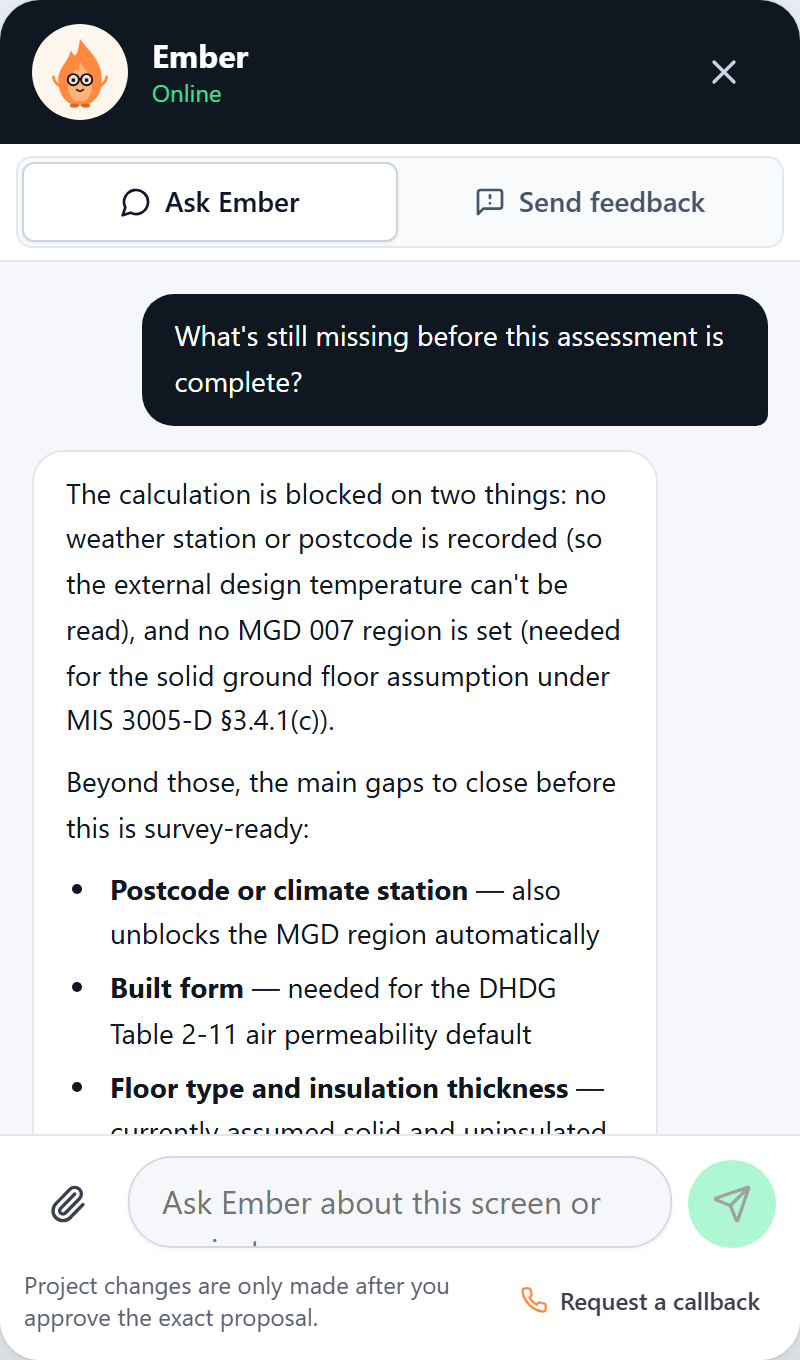 Ask what's missing
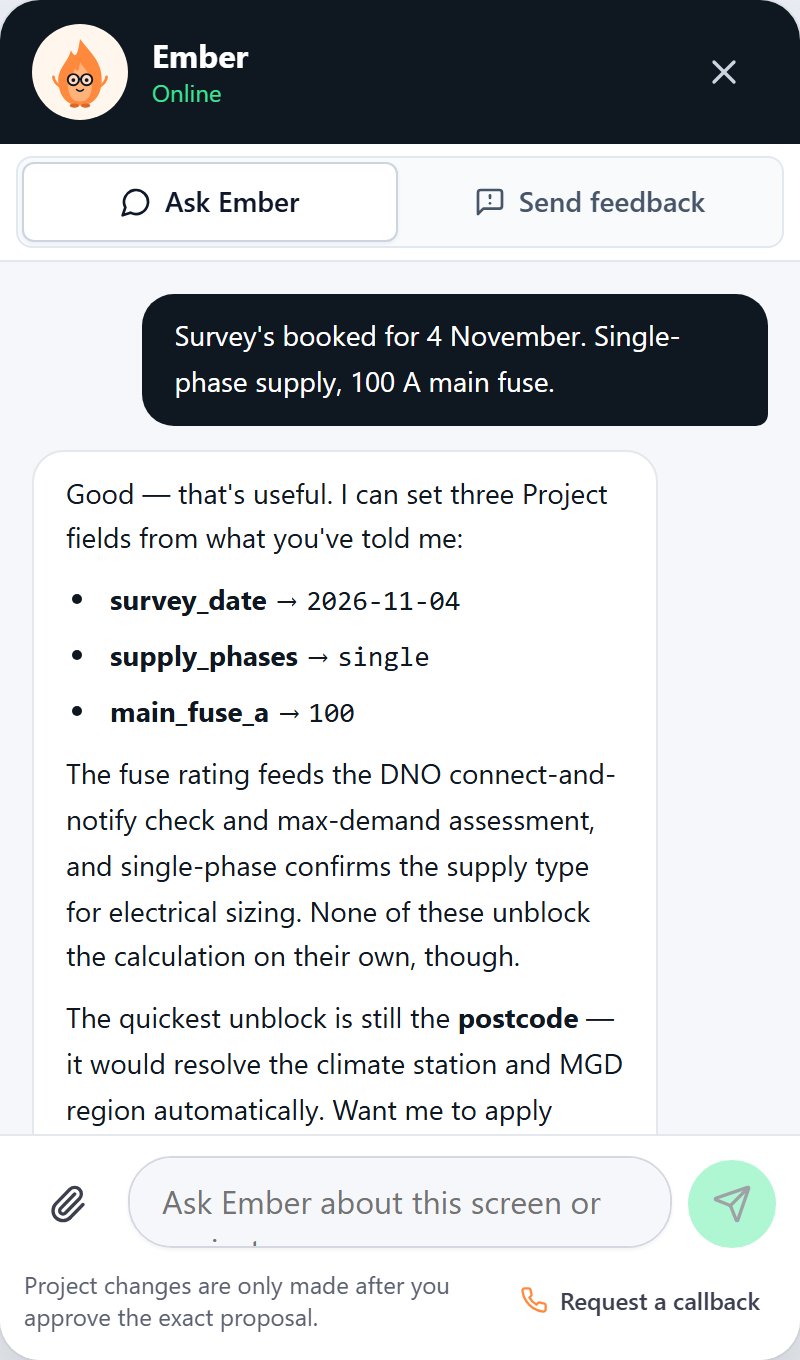 Fill in details by chat
What Ember is not
Ember is there to make a design easier to understand and complete. It does not certify a design, and it is not a substitute for a qualified installer's survey. Results based on EPCs and floor plans are estimates, and Ember treats them that way.
When you are ready to go ahead, MCS's installer search is the place to find a certified installer. If you would like to see and hear a heat pump running in a real home first, Nesta's Visit a Heat Pump connects you with an owner nearby.
Help us shape it
Ember is new, and we would like to hear where it helps and where it falls short. Use the Send feedback tab in the Ember window, or email info@heatlens.co.uk. If you have not tried HeatLens yet, the platform tour shows how a project comes together, and the features page covers the rest.
References
- DESNZ (2026). Public Attitudes Tracker: Heat and energy use in the home, Spring 2026, UK.
- Which? (2026). Beyond Affordability: why heat pumps feel like a gamble.
HeatLens figures are based on EPC and floor plan information, which may contain inaccuracies. Designs must be checked and surveyed by a qualified MCS installer. If you think anything here is wrong, we would rather know: info@heatlens.co.uk.